

-
vigilantinvestigationagency@gmail.com
Send Email
-
Bharthal, Dwarka Sector 26, New Delhi – 110077, India
Visit Our Office
+91 62-995 5-3308
Confidentiality Guaranteed
+91 62-995 5-3308
Confidentiality Guaranteed
Blog Details
-
vigilant Investigation Agency. > Crime News > Matrimonial Cyber Fraud Investigation: Delhi Police Bust Agra Call Centre
15
Sep
Sep
Matrimonial Cyber Fraud Investigation: Delhi Police Bust Agra Call Centre
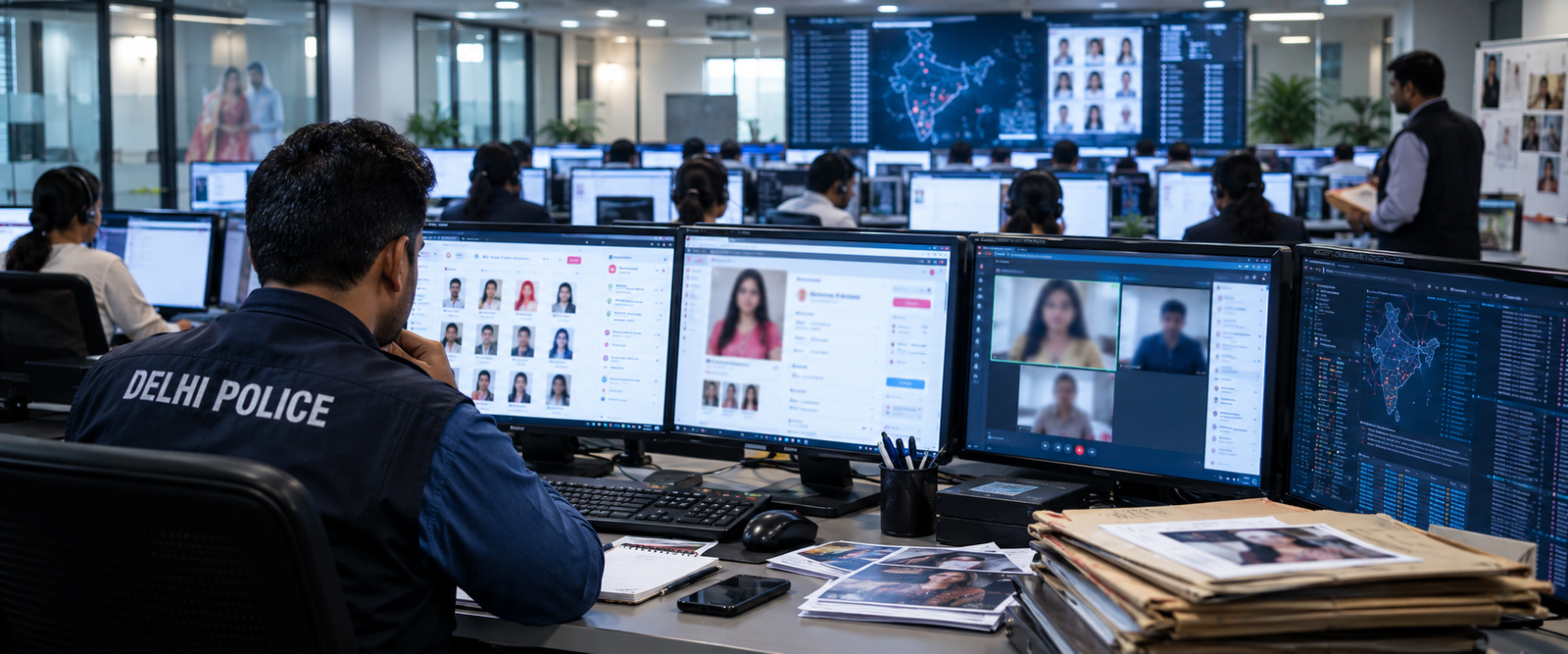
A major matrimonial cyber fraud investigation has uncovered an organised pan-India racket allegedly operating through a call centre in Agra. The Central District Cyber Police of Delhi have arrested an alleged mastermind, who is reported to be a practising advocate, along with an operational manager in connection with the case.
According to reports published on September 15, 2026, the suspected operation allegedly used a matrimonial portal as a front to approach people looking for marriage or relationship opportunities. Investigators are examining how the network attracted potential victims, communicated with them and allegedly collected money through fraudulent representations.
How the Matrimonial Cyber Fraud Investigation Began
The matrimonial cyber fraud investigation was initiated after information about an organised online matrimonial fraud network came to the attention of Delhi Police’s Central District Cyber Police.
Investigators reportedly found that the suspected operation was being run from Agra while targeting people across different parts of India.
The alleged use of a dedicated call-centre setup made the operation appear more organised than an isolated online scam. Police are examining the people involved, their respective roles and the communication infrastructure allegedly used by the group.
The case highlights how online matrimonial platforms and related services can potentially be misused to target people who are actively searching for marriage partners.
Alleged Use of a Matrimonial Portal
According to the reports, the alleged call centre operated under the guise of a branded matrimonial portal identified as shaadipartner.com.
Investigators suspect that the platform was used to create an appearance of a legitimate matrimonial service while people working from the call centre allegedly contacted prospective victims.
The exact number of people targeted and the total amount allegedly obtained through the suspected operation remain subjects of the investigation.
Police are continuing to examine digital records and other evidence to establish the complete scale of the alleged fraud.
Alleged Role of Fake Matrimonial Profiles
A key concern in matrimonial fraud cases is the possibility of misleading profiles or false identities being used to establish trust.
In this case, reports indicate that the suspected network allegedly used staged communications and representations to convince targets that they were dealing with genuine matrimonial prospects or services.
ThePrint reported that the alleged racket involved fake brides and staged calls, indicating that investigators are looking into whether scripted interactions were used as part of the operation.
Such allegations, if established during the investigation, would demonstrate how social engineering can be combined with matrimonial services to manipulate victims emotionally and financially.
Advocate Allegedly Identified as Mastermind
One of the notable aspects of the case is the reported arrest of a practising advocate who police allege was the mastermind of the operation.
An operational manager was also arrested as part of the investigation.
The arrests are significant because they suggest that investigators are looking beyond individual callers and examining the organisational structure allegedly behind the operation.
Police are expected to establish the specific responsibilities of each accused person and determine whether other individuals were involved.
As the investigation is ongoing, allegations against the accused remain subject to the legal process and further investigation.
Why Matrimonial Cyber Fraud Is a Serious Concern
Online matrimonial fraud can be particularly damaging because it often involves both financial and emotional manipulation.
People searching for a life partner may share personal information, photographs, contact details and other sensitive information during online conversations. If someone deliberately creates a false identity or misrepresents their intentions, the victim may be exposed to financial loss as well as emotional distress.
Fraudsters may also attempt to establish trust over a period of time before making financial demands or introducing additional charges.
The Agra case demonstrates why online matrimonial interactions require careful verification before important decisions are made.
Warning Signs of a Potential Matrimonial Scam
While every online interaction is not fraudulent, certain warning signs should be treated carefully.
These may include:
A matrimonial profile that cannot be independently verified
Inconsistent information about a person’s identity, employment or family background
Pressure to move conversations quickly to private messaging platforms
Requests for money, gifts, fees or emergency financial assistance
Claims that money is urgently required for travel, medical treatment or legal problems
Reluctance to participate in a genuine video call or meet through appropriate channels
Contradictory details appearing across different profiles
Pressure to make financial decisions before proper verification
Requests for sensitive documents or personal information without a clear reason
These warning signs do not automatically prove that someone is a fraudster, but they can indicate that additional verification is necessary.
Importance of Background Verification
The case also highlights the importance of background verification before marriage.
A person’s identity, professional information, residential details and other relevant claims should be assessed carefully before making major personal or financial commitments.
Online information alone may not always provide a complete picture. Profiles can contain inaccurate information, outdated details or deliberately misleading claims.
For families considering a matrimonial relationship, independent verification can help identify inconsistencies before they become serious problems.
Digital Evidence in Matrimonial Fraud Cases
Digital evidence can play an important role in investigating organised online fraud.
Investigators may examine relevant communications, digital accounts, transaction records and other legally obtained evidence to establish connections between suspects and alleged victims.
In an organised call-centre operation, investigators may also need to determine how different people were connected and what roles they allegedly played.
The Agra investigation demonstrates how a case that begins with online matrimonial interactions can develop into a wider cybercrime investigation involving multiple people and locations.
A Pan-India Operation
The reported operation was not limited to a single local target.
Delhi Police described the suspected racket as a pan-India matrimonial cyber fraud operation, indicating that investigators are examining victims or targets from different parts of the country.
Operating from one city while allegedly targeting people across India can make such investigations more complicated.
Law-enforcement agencies may need to coordinate across jurisdictions to identify victims, trace transactions and establish the movement of digital evidence.
What People Should Check Before Trusting an Online Matrimonial Profile
People using matrimonial websites or apps should avoid making important decisions based solely on information provided through an online profile.
Basic identity and background verification can be particularly important before:
Sharing sensitive personal documents
Making financial transfers
Sending expensive gifts
Entering into business or financial arrangements
Making marriage commitments
Sharing confidential family information
A genuine matrimonial relationship should not normally require unexplained financial payments simply to continue communication.
If a person becomes aggressive, secretive or unusually persistent when verification is requested, it may be appropriate to step back and seek independent advice.
Investigation Continues
The arrest of the alleged mastermind and operational manager is an important development, but the investigation is continuing.
Delhi Police are examining the alleged call-centre structure, digital records and other evidence to determine the full scope of the operation.
Investigators may also look into whether additional people were involved and whether similar complaints from other parts of India are connected to the same network.
The total number of victims and the complete financial impact of the alleged operation will become clearer as the investigation progresses.
What This Case Teaches Us
The Agra matrimonial cyber fraud case is a reminder that online matrimonial services can be exploited through carefully constructed identities and organised communication.
Technology makes it easier for people to connect across cities and countries, but it can also provide opportunities for fraudsters to hide behind false profiles and scripted conversations.
For people searching for a life partner online, verification should come before trust, especially when money or sensitive personal information is involved.
The Delhi Police investigation is now focused on uncovering the complete network behind the alleged matrimonial cyber fraud operation and identifying any additional individuals who may have participated in it.
The case also reinforces a broader lesson: a convincing matrimonial profile is not necessarily proof of a genuine identity. Independent and lawful background verification can help people make better-informed decisions before entering into important personal relationships.

