

-
vigilantinvestigationagency@gmail.com
Send Email
-
Bharthal, Dwarka Sector 26, New Delhi – 110077, India
Visit Our Office
+91 62-995 5-3308
Confidentiality Guaranteed
+91 62-995 5-3308
Confidentiality Guaranteed
Blog Details
-
vigilant Investigation Agency. > Awareness > How to Identify a Fake Profile on a Matrimonial Website
17
Sep
Sep
How to Identify a Fake Profile on a Matrimonial Website
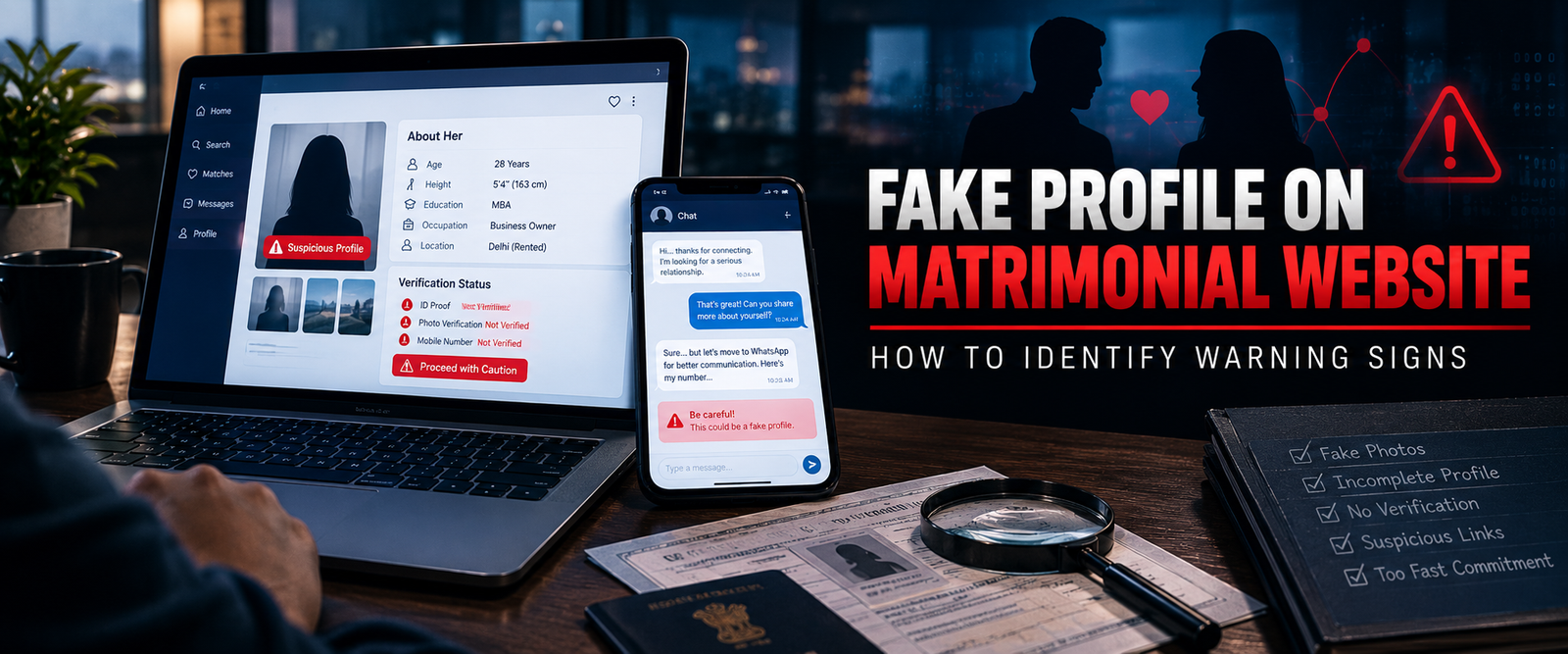
Fake Profile on Matrimonial Website can be difficult to identify because a suspicious profile may contain genuine-looking photographs, impressive professional details and carefully written personal information.
Matrimonial websites have made it easier for people and families to connect with potential marriage partners. However, the same online environment can also be misused by individuals who create false identities, hide important information or use attractive profiles to gain someone’s trust.
A profile may contain convincing photographs, an impressive profession, a good education and detailed family information, yet some of these details may not be genuine.
This does not mean that every incomplete or unusual profile is fraudulent. The important point is to verify significant information before making emotional, personal or financial decisions.
What Is a Fake Profile on Matrimonial Website?
A Fake Profile on Matrimonial Website may contain false, misleading or deliberately concealed information about the person behind it.
The identity itself may be genuine while important details are false. For example, someone may provide a real name but misrepresent their occupation, marital status, income, education, location or family background.
In some cases, completely fabricated identities and photographs may also be used.
1. Be Careful With Profiles That Look Too Perfect
A profile that appears unusually perfect deserves a closer look.
Extremely attractive photographs, an impressive career, exceptional income, ideal family background and an immediate interest in marriage can create a strong emotional impression.
There is nothing wrong with having a successful or attractive profile. However, important claims should be verified independently instead of being accepted simply because they appear on a matrimonial website.
2. Check the Photographs Carefully
Photographs are often one of the first things people notice on matrimonial platforms.
A profile using only highly edited photographs, model-like pictures or very limited images may require additional verification.
Reverse image searching can sometimes help identify whether a photograph appears elsewhere online. However, finding a similar photograph does not automatically prove that a profile is fake.
The purpose of checking photographs is to identify inconsistencies that may require further verification.
3. Compare the Profile With Real-Life Information
Pay attention to whether the information provided online remains consistent during conversations.
For example, the person’s:
Job title
Workplace
Education
City
Age
Family details
Relationship history
Lifestyle information
should not repeatedly change without a reasonable explanation.
Small differences can happen naturally, but significant contradictions may be a reason to slow down and verify the information.
When reviewing a Fake Profile on Matrimonial Website, consistency between the online profile and information shared during conversations can be an important consideration.
4. Verify the Profession and Workplace
Occupation is an important part of many matrimonial profiles.
Someone may claim to be a senior executive, business owner, doctor, engineer, government employee or overseas professional.
Instead of relying only on a profile description, relevant professional information can be verified through lawful and appropriate sources.
This is particularly important when the person’s claimed profession is being used to establish financial credibility or social status.
5. Be Alert When Marriage Discussions Move Too Quickly
Some people may become emotionally close very quickly and start discussing marriage before both sides have had enough opportunity to understand each other.
Fast emotional attachment is not proof of fraud. However, when rapid commitment is combined with secrecy, inconsistent information or unusual financial requests, additional caution is appropriate.
A genuine relationship should allow reasonable time for questions, conversations and verification.
6. Never Ignore Financial Requests
One of the most serious warning signs is an unexpected request for money.
The person may claim to need financial help because of:
A medical emergency
Travel problems
Visa or immigration issues
Business difficulties
Family emergencies
Customs or legal problems
An urgent payment
A request may initially appear believable because emotional trust has already developed.
Never transfer money simply because someone has presented a convincing personal story. Financial claims should be independently verified.
Financial pressure combined with misleading information can be an important warning sign when assessing a Fake Profile on Matrimonial Website.
7. Be Careful With Overseas or NRI Profiles
International matrimonial profiles can require additional attention because verifying information across countries can be more complicated.
A person may claim to live or work abroad while providing limited information about their actual residence, employment or family.
Important details should be checked through appropriate and lawful sources before major decisions are made.
Distance should not become a reason to skip verification.
8. Look for Inconsistencies in Family Information
Matrimonial relationships often involve more than two individuals. Family information can therefore be an important part of the verification process.
Pay attention to unexplained differences regarding parents, siblings, previous marriage, children, residence or other major family details.
If an important fact is repeatedly avoided or changed, it may be worth seeking clarification before proceeding further.
9. Video Calls Can Help, But They Are Not Complete Verification
Video calls can provide some reassurance that the person actually exists and matches their photographs.
However, a video call alone cannot establish someone’s complete identity, marital status, employment, financial position or family background.
A person can be genuine while still providing false information about important parts of their life.
Identity verification and background verification are therefore separate considerations.
10. Do Not Share Sensitive Documents Too Early
Trust should develop gradually.
Avoid casually sending sensitive documents, banking information, passwords, OTPs or unnecessary personal records to someone you have only met online.
Even photographs of identity documents can potentially be misused.
Share personal information only when there is a legitimate reason and you understand how it will be handled.
11. Search for the Person’s Digital Footprint
A person’s online presence can sometimes provide useful information.
You may find professional profiles, business information, public social media accounts or other publicly available records.
The information should be interpreted carefully. A lack of online presence does not automatically indicate fraud, and information found online should not be treated as proof without proper verification.
The objective is to identify inconsistencies and questions that deserve clarification.
12. When Should a Matrimonial Profile Be Verified?
Verification becomes particularly important before major commitments such as:
Engagement
Marriage arrangements
Financial transactions
Relocation to another city or country
Joint business or financial decisions
Sharing sensitive personal information
The earlier an important discrepancy is identified, the easier it may be to make a careful decision.
How Professional Verification Can Help
When information provided through a matrimonial profile cannot be adequately confirmed through normal conversations, professional background verification may provide an additional layer of fact-checking.
A professional detective or investigation agency may, depending on the circumstances and applicable law, assist with areas such as identity verification, background checks, address verification, employment-related verification and other relevant fact-finding.
Such verification is not about judging a person based on assumptions. Its purpose is to establish whether important information provided during the matrimonial process is consistent with available facts.
Any investigation should be conducted through lawful means, with appropriate respect for privacy and confidentiality.
What If You Already Suspect a Fake Profile?
Do not confront the person aggressively or make immediate accusations.
First, preserve relevant information such as profile details, messages, photographs, transaction records and other communications.
Avoid sending additional money or sensitive information while the situation remains unclear.
If there has been financial loss, identity misuse, threats or suspected cyber fraud, appropriate authorities and qualified professionals may need to be contacted.
Fake Profile Does Not Always Mean Fake Person
This distinction is important.
A person can have an incomplete profile without intending to commit fraud. Someone may also use an old photograph, provide limited information or make an honest mistake.
Therefore, one suspicious detail should not automatically be treated as proof that someone is fraudulent.
A pattern of serious inconsistencies, deliberate concealment, false claims or financial manipulation deserves much greater attention.
Final Thoughts
A matrimonial website can be a useful place to meet a potential partner, but an online profile should only be considered the beginning of the process.
Before making an important personal decision, take time to understand the person, compare the information provided, verify significant claims and remain cautious about financial or sensitive requests.
Trust is important in any relationship, but informed trust is built through consistency, transparency and reasonable verification.
When marriage is involved, taking a little extra time to confirm important facts can help prevent much bigger problems later.

