

-
vigilantinvestigationagency@gmail.com
Send Email
-
Bharthal, Dwarka Sector 26, New Delhi – 110077, India
Visit Our Office
+91 62-995 5-3308
Confidentiality Guaranteed
+91 62-995 5-3308
Confidentiality Guaranteed
Blog Details
-
vigilant Investigation Agency. > Awareness > Digital Arrest Scam in India: Why People Still Fall for It
18
Sep
Sep
Digital Arrest Scam in India: Why People Still Fall for It
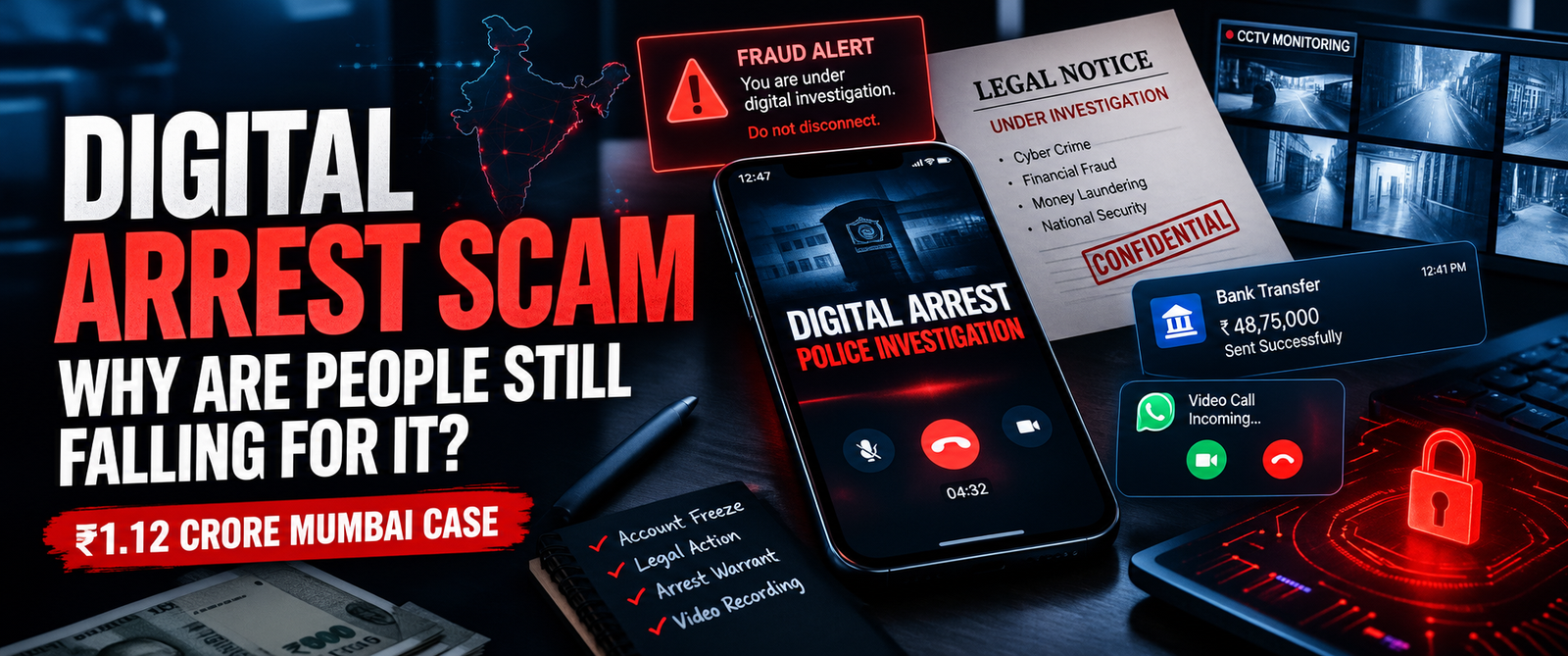
Digital Arrest Scam in India has become one of the most worrying forms of cyber fraud in recent years. Almost every week, we hear about someone being threatened by fake police officers, CBI officials, telecom officers or other government authorities. Victims are told that their phone number, Aadhaar or bank account has been connected to a serious crime. They are then pressured to stay on video calls, keep the matter secret and transfer money.
The surprising part is that most people have already heard about digital arrest scams. Police warnings are shared on WhatsApp. Cybercrime awareness messages appear on social media. News reports regularly tell us that no genuine police officer can arrest someone through a video call.
Still, people continue to lose lakhs and crores of rupees.
So the real question is not simply whether people are aware of these scams.
The bigger question is: Why does awareness sometimes fail when a real scammer is standing on the other side of the phone?
The answer has a lot to do with fear, pressure, trust and human psychology.
The Recent Mumbai Case
A recent Mumbai case once again shows how damaging this type of fraud can be.
According to police, six people were arrested in connection with an alleged digital arrest scam involving a 68-year-old man. The victim was allegedly contacted by people pretending to be officials and was told that his identity and SIM card were connected to a serious money-laundering investigation.
The scammers allegedly used video calls, fake documents and threats to make the situation appear genuine. The victim was reportedly kept under this so-called digital arrest for an extended period and was allegedly pressured into transferring ₹1.12 crore.
Among those arrested were an IIT Delhi graduate and a private bank operations manager.
The case is disturbing not only because of the amount involved, but because of the way the victim was allegedly kept under continuous psychological pressure.
It shows that these scams are not always about stealing information from a computer.
Sometimes, the criminals simply try to take control of a person’s mind through fear.
Digital Arrest Is Not a Real Arrest
One of the most important things people need to understand is that digital arrest is not a legal form of arrest.
A police officer, CBI officer or any other government official cannot legally place someone under arrest simply by keeping them on a WhatsApp or video call.
Yet scammers use the phrase “digital arrest” because it sounds official and frightening.
They may tell the victim to sit in front of a camera.
They may ask them not to leave the room.
They may claim that their phone is being monitored.
They may show fake identity cards, notices or legal documents.
The purpose is to make the victim feel that something serious and official is happening.
Once that belief is created, the victim may start following instructions without questioning them.
Why Do People Still Fall for It?
This is where the human side of the Digital Arrest Scam in India becomes important.
It is easy to look at a victim after the incident and say:
“Why didn’t they just hang up?”
“Why did they transfer the money?”
“Didn’t they know about digital arrest scams?”
But fear does not work logically.
Imagine receiving a call from someone who claims to be a police officer.
The person knows your name.
They know your phone number.
They tell you that your Aadhaar has been linked to a crime.
Then another person joins the video call and introduces himself as a senior officer.
You are shown documents.
You are told that there is an arrest warrant.
Then comes the warning:
“If you disconnect this call, police action will begin.”
At that moment, you are not thinking like someone reading a cybercrime awareness article.
You are thinking like someone who believes that their freedom and family may be at risk.
That difference is extremely important.
Fear Can Make People Make Unusual Decisions
Most of us believe we would never fall for a scam.
We think we are careful.
We know that OTPs should not be shared.
We know that banks do not normally ask for passwords.
We know that unknown links can be dangerous.
But a Digital Arrest Scam in India often does not begin by asking for an OTP.
It begins with a story.
A frightening story.
The scammer creates a situation where the victim believes there is an immediate legal problem.
Once fear takes over, the conversation changes from:
“Is this real?”
to:
“How can I fix this?”
That is the moment scammers are looking for.
Authority Makes the Scam More Convincing
Another powerful part of these scams is authority.
People naturally take police officers, judges, government officials and financial institutions seriously.
When someone introduces themselves as a senior police officer and speaks confidently, many people instinctively become more respectful and careful.
The scammer may use official-looking language.
They may mention case numbers.
They may use the names of real departments.
They may even have several people appear on the same video call.
All of this can create the appearance of a genuine investigation.
But an official-looking conversation is not proof that the person is genuine.
A uniform on a screen is not proof.
A document shown during a video call is not proof.
A caller knowing your personal details is not proof.
Independent verification is what matters.
The Role of Isolation
One of the most worrying patterns in digital arrest cases is isolation.
Victims may allegedly be told not to speak to family members.
They may be told that the investigation is confidential.
They may be warned that talking to anyone could make the situation worse.
This is extremely effective from a psychological point of view.
When a person is alone, they have nobody beside them to question the story.
A family member may immediately recognize something suspicious.
A friend may say, “Hang up and call the police station yourself.”
A son or daughter may search the official number and discover that the entire story is false.
That is why keeping communication open with family can be an important layer of protection.
Why Education Does Not Always Protect People
Another common reaction after these incidents is:
“How can an educated person fall for this?”
But education does not make anyone immune to fear.
A person can be highly educated and still become confused when confronted with a sudden threat involving police, courts, money and family.
The recent Mumbai case itself involved alleged participation by people with professional and educational backgrounds.
This tells us something important.
Cybercrime is not always about finding people who know nothing about technology.
Sometimes it is about finding a moment when a person’s emotions become stronger than their ability to calmly verify information.
Awareness Is More Than Reading the News
We see cybercrime news every day.
We read about someone losing ₹10 lakh.
Then someone loses ₹50 lakh.
Then someone loses ₹1 crore.
Sometimes the amount reaches several crores.
We read the story, feel shocked for a few minutes and then move on.
But simply reading a warning does not guarantee that we will remember what to do when the same situation happens to us.
Real awareness means preparing before the emergency happens.
It means knowing that if someone suddenly claims to be a police officer and threatens arrest, the first response should not be panic.
The first response should be:
Stop. Think. Verify.
Families Have an Important Role
Families can play a major role in preventing serious financial losses.
If your parents or elderly relatives use smartphones and online banking, talk to them about digital arrest scams.
But do not simply tell them:
“Don’t get scammed.”
Explain what a scammer may actually say.
Tell them that nobody should be able to force them to stay on a video call.
Tell them that they should never transfer money because someone threatens them with arrest.
Tell them that they should call a family member if a caller says their Aadhaar, SIM card or bank account is connected to a crime.
Most importantly, tell them that they will not be blamed for calling the family.
That last point matters.
A victim who believes that their family will be angry may remain silent.
A victim who knows that their family will help them is more likely to speak up.
Why People Sometimes Hide the Fraud
There is another human emotion that scammers can take advantage of: embarrassment.
After losing money, some victims become afraid of telling their family.
They may think:
“What will everyone say?”
“How could I make such a mistake?”
“They will think I am careless.”
That fear can delay reporting.
And in cyber fraud, time can be important.
Instead of blaming someone after a scam, families should create an environment where a person feels safe saying:
“I think something has gone wrong. Please help me.”
There should be no shame in asking for help.
What Should You Do During a Digital Arrest Scam?
If someone calls and claims that you are under investigation or “digitally arrested,” do not allow fear to control your next decision.
Do not transfer money simply because the caller threatens you.
Do not share OTPs, PINs, CVV numbers, passwords or other confidential banking information.
Do not trust a phone number simply because the caller claims to be from the police or another government department.
End the conversation and independently verify the information through official channels.
Call someone you trust.
If money has already been transferred, contact your bank immediately and report the incident to the appropriate cybercrime authorities as soon as possible.
The Government of India has also issued warnings about digital-arrest and impersonation scams and advised citizens to remain cautious.
The Numbers Tell Their Own Story
Digital arrest fraud has become serious enough to attract attention at the national level.
According to information placed before the Supreme Court, complaints relating to digital-arrest scams on the National Cyber Crime Reporting Portal stood at 1,23,672 in 2024.
The number fell to 58,239 in 2025 and stood at 16,377 up to June 30, 2026.
The decline is encouraging, but the numbers still represent a large number of people who reported being targeted.
A separate CBI investigation mentioned in the Supreme Court record identified 238 victims, 67 first-layer bank accounts and transactions of approximately ₹80 crore in one alleged network.
These figures show that digital arrest fraud is not simply a problem involving a few random phone calls.
In some cases, investigators have found networks involving multiple people, bank accounts, SIM cards and money transfers.
The Human Cost Is Bigger Than the Amount of Money
When we read that someone lost ₹1.12 crore, ₹1.28 crore, ₹2.96 crore or several crores, our attention naturally goes to the money.
But the financial loss is only one part of the story.
Imagine watching your lifetime savings disappear because you believed that you were trying to avoid arrest.
Imagine being afraid to tell your family.
Imagine spending days believing that your phone was being monitored and that your freedom was at risk.
That emotional pressure can be devastating.
This is why victims should not simply be described as careless.
They were targeted.
They were manipulated.
And in many cases, the criminals deliberately created an environment where fear made clear thinking difficult.
We Need to Change the Way We Talk About These Scams
Instead of asking:
“Why did the victim fall for it?”
Maybe we should ask:
“What can we do so that our family knows what to do if this happens?”
Instead of forwarding another awareness message, talk about it at home.
Instead of assuming that elderly parents already understand these scams, explain them patiently.
Instead of laughing at someone who made a mistake, help them report it quickly.
Cyber awareness should not be about making people afraid of every phone call.
It should be about giving people enough confidence to stop when something feels wrong.
The Most Important Lesson
The stories coming out of Mumbai, Pune, Delhi, Surat and other parts of India may involve different victims and different amounts of money.
But the basic pattern is often similar.
A stranger creates authority.
Then comes an accusation.
Then fear.
Then pressure.
Then isolation.
And finally, a demand for money.
That is why the most important rule is simple:
Never make a major financial decision while someone is frightening or threatening you over a phone or video call.
Stop the conversation.
Talk to someone you trust.
Verify the claim independently.
And if you have already lost money, report it immediately instead of remaining silent.
We cannot prevent every cybercrime.
But we can make sure that fear does not make us face one alone.
The next digital arrest scam may not begin with someone else’s phone.
It could begin with yours.
And the best protection is not simply knowing that the scam exists.
It is knowing what you will do when the call actually comes.

