

-
vigilantinvestigationagency@gmail.com
Send Email
-
Bharthal, Dwarka Sector 26, New Delhi – 110077, India
Visit Our Office
+91 62-995 5-3308
Confidentiality Guaranteed
+91 62-995 5-3308
Confidentiality Guaranteed
Blog Details
-
vigilant Investigation Agency. > Awareness > Allahabad High Court Same-Sex Couple Gets Police Protection
21
Sep
Sep
Allahabad High Court Same-Sex Couple Gets Police Protection
The Allahabad High Court Same-Sex Couple case has drawn attention to the rights of consenting adults who choose their own relationships and living arrangements.
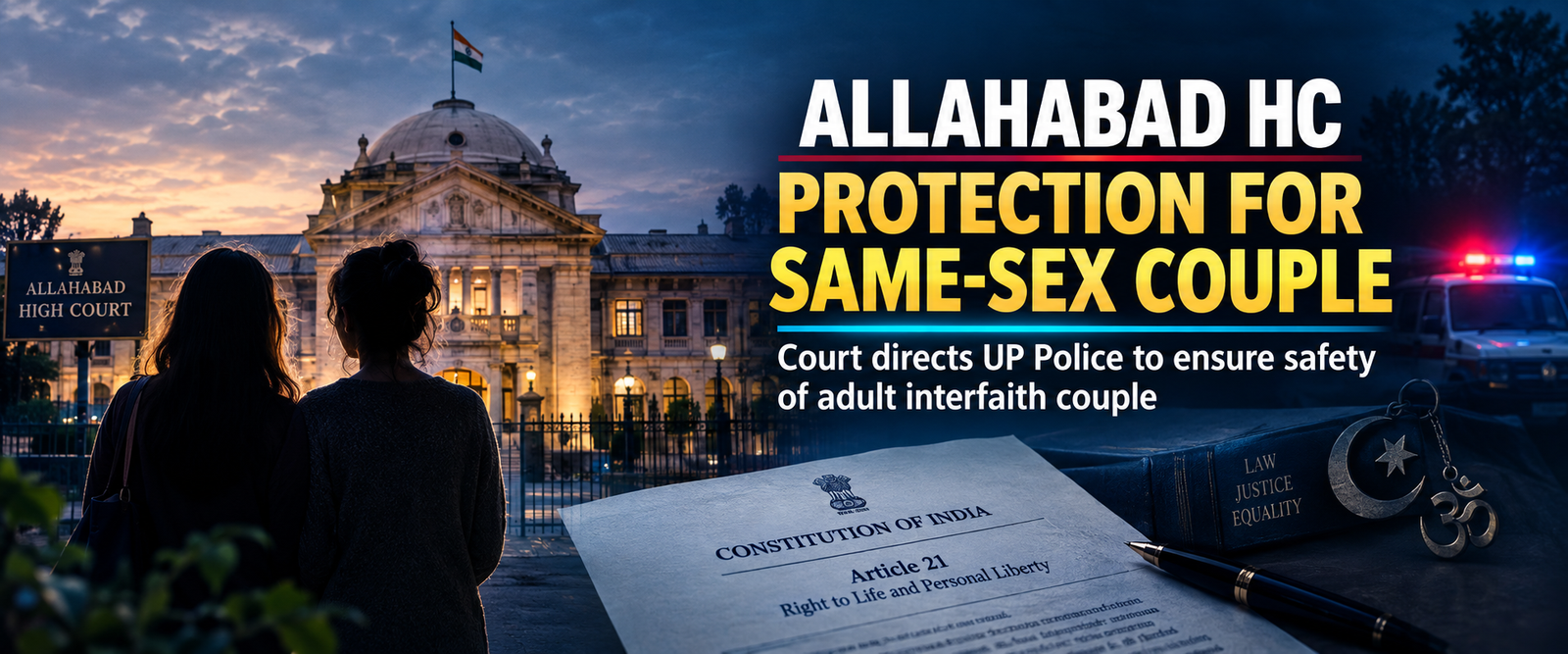
The Allahabad High Court has directed Uttar Pradesh Police to provide protection to two adult women from different religious backgrounds who are in a same-sex live-in relationship and approached the court after alleging threats and interference from family members.
The court’s order focused on their safety, personal liberty and voluntary decision to live together. It did not grant legal recognition to a same-sex marriage.
Why Did the Couple Approach the Court?
The two women told the court that they were adults and had voluntarily decided to live together.
According to the case proceedings, the couple alleged that family members and other private individuals were interfering with their relationship and that they feared for their safety.
They approached the High Court seeking protection for their life and liberty.
During the proceedings, both women personally appeared before the court. They confirmed that their decision to live together was voluntary and that they wanted to continue their relationship without outside interference.
The court also examined documents relating to their age and considered their statements before deciding the protection request.
Court Considered Their Personal Choice
A significant part of the Allahabad High Court Same-Sex Couple case was the question of whether consenting adults can choose to live together even when their families or other people disagree with the relationship.
The court considered the constitutional principles surrounding personal liberty, privacy and individual choice.
After interacting with the women, the court found that they were adults and had voluntarily chosen to live together without coercion, fear or undue influence.
The court therefore treated their decision as a matter of personal autonomy.
Live-In Relationship Is Separate From Marriage
The order also makes an important distinction between a person’s right to live with another adult and the legal recognition of marriage.
The court did not declare that the women were legally married.
Instead, the case concerned their right to live together peacefully and seek protection if their safety or liberty was threatened.
The legal status of same-sex marriage remains a separate issue. The Supreme Court has previously held that legal recognition of marriage for same-sex couples is a matter for the legislature, while constitutional protections relating to privacy, choice and personal relationships continue to apply.
What Protection Did the Court Order?
The Allahabad High Court allowed the couple to live together peacefully.
The court directed that if they faced obstruction or threats, they could approach the concerned Police Commissioner, Senior Superintendent of Police or Superintendent of Police.
The police would then provide appropriate protection after verifying that the two individuals were adults and that their decision to live together was voluntary.
The direction is primarily focused on their physical safety and personal liberty.
Family Opposition and Relationship Disputes
Relationship disputes can become complicated when family members strongly oppose a couple’s decision.
In this case, the women alleged that their families were interfering with their peaceful life and that they needed protection.
The court’s approach highlights an important distinction between disagreement and unlawful interference.
People may have personal or social disagreements about another adult’s relationship, but such disagreement does not automatically give anyone the right to threaten, intimidate or physically interfere with consenting adults.
The protection of life, dignity and personal liberty remains an important constitutional consideration.
What the Allahabad High Court Order Does Not Mean
The Allahabad High Court Same-Sex Couple order should not be interpreted as a nationwide legal recognition of same-sex marriage.
The court was dealing with the specific circumstances of two adult women who said they had voluntarily chosen to live together and were seeking protection from alleged interference.
The immediate issue before the court was their right to live peacefully and seek police protection when facing threats or obstruction.
Marriage recognition is a separate legal question.
Why This Case Is Important for Relationship News
The case is significant because relationship disputes are not always limited to disagreements between two partners.
In some situations, couples may face family pressure, threats, harassment, stalking or attempts to forcibly separate them.
When a dispute involves a genuine safety concern, preserving relevant evidence can become important. Messages, call records, photographs, CCTV footage and other lawful evidence may help establish what actually happened.
At the same time, sensitive relationship cases should be handled carefully. Personal photographs, private conversations and identifying information should not be unnecessarily shared publicly.
This is particularly important when the people involved may already be facing threats or pressure from relatives or other individuals.
Personal Liberty and the Right to Live Together
The Allahabad High Court’s reasoning placed significant emphasis on the personal liberty of adults.
The court found that the women were adults and had made their decision voluntarily. On that basis, their choice to live together could not simply be obstructed by family members or other people.
The court also made clear that the absence of marital recognition does not give third parties the freedom to interfere with the dignity or physical safety of adult citizens.
What Couples Facing Similar Threats Can Do
People facing serious threats because of a relationship should first consider their immediate safety.
Depending on the circumstances, they may approach the police or other appropriate legal authorities and preserve evidence of threats or harassment.
Where there are allegations of stalking, intimidation, unlawful confinement, violence or other criminal conduct, the specific facts of the case determine what legal remedies may be available.
Professional legal advice can also help a person understand the appropriate course of action.
A Case About Choice and Safety
The Allahabad High Court Same-Sex Couple case ultimately focuses on two adults who said they had voluntarily chosen to live together and wanted protection from alleged interference.
The court did not decide the broader question of same-sex marriage. Instead, it dealt with the immediate issue of personal liberty and safety.
The order reinforces the distinction between the freedom of consenting adults to make personal decisions about their lives and the separate legal question of marriage recognition.
For relationship-related disputes, the case also serves as a reminder that personal choices, family disagreements and genuine threats to safety are different issues and should be assessed according to the facts and applicable law.
The High Court’s order was passed on September 14, 2026, and subsequent reports brought the matter into wider public attention on September 21.

