

-
vigilantinvestigationagency@gmail.com
Send Email
-
Bharthal, Dwarka Sector 26, New Delhi – 110077, India
Visit Our Office
+91 62-995 5-3308
Confidentiality Guaranteed
+91 62-995 5-3308
Confidentiality Guaranteed
Blog Details
-
vigilant Investigation Agency. > Awareness > Fake Customer Care Number Scam: How It Works and How Scammers Trick You
18
Sep
Sep
Fake Customer Care Number Scam: How It Works and How Scammers Trick You
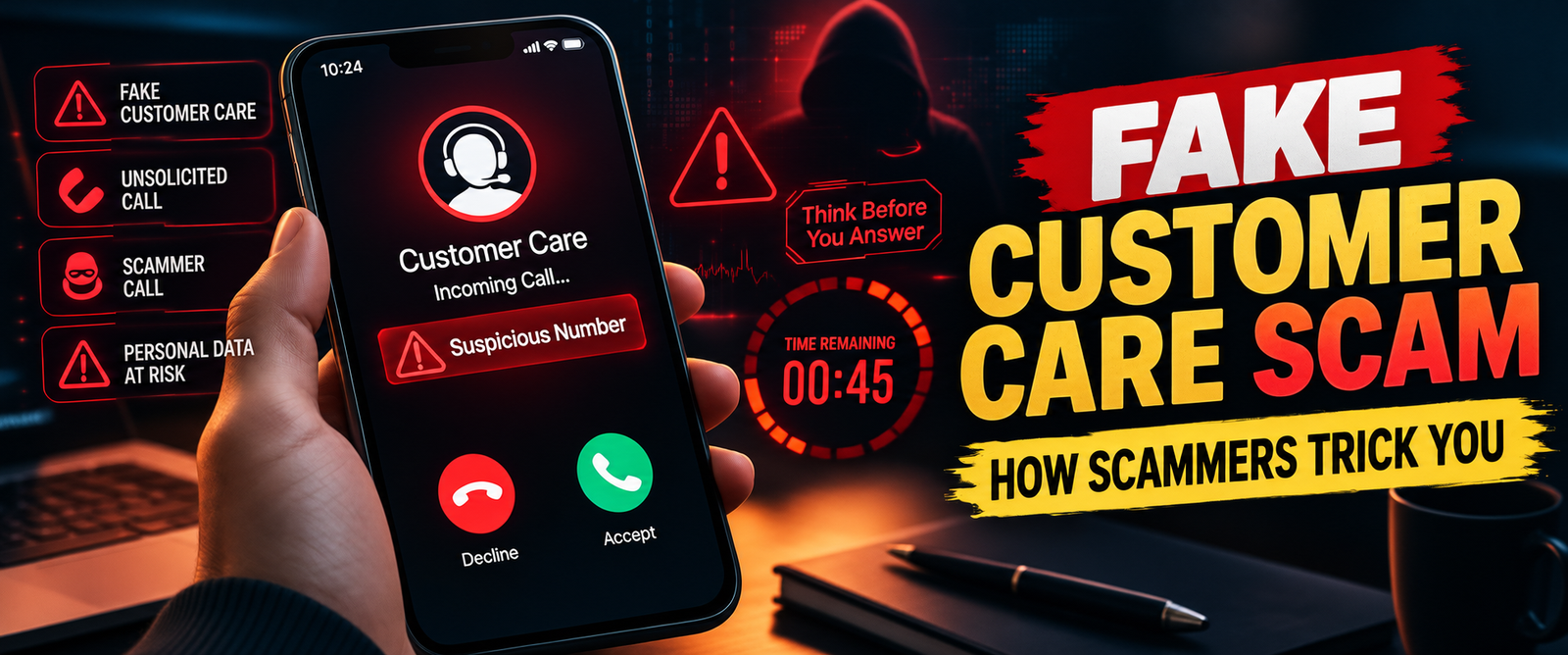
A Fake Customer Care Number Scam can start with something that feels completely normal. You may be looking for help with a bank transaction, a shopping order, a payment problem, a travel booking or an online service. You search for a customer care number, find a number that looks genuine and call it.
The person on the other side sounds professional and confident. They may introduce themselves as a customer support executive and immediately start discussing your problem.
That is where the trap can begin.
Fake customer care scams work because they do not always depend on complicated technology. In many cases, scammers rely heavily on trust, urgency, fear and human psychology to make people act before they have time to think.
How Does a Fake Customer Care Number Scam Work?
The basic idea is simple: a scammer pretends to represent a legitimate company, bank, marketplace, payment service or another organization.
The fake number may appear in search results, social media posts, online advertisements, fake websites or other places where people normally look for support.
India’s cybercrime authorities have specifically warned about fake customer-care numbers and helplines being used to defraud citizens. The National Cyber Crime Reporting Portal also classifies phone-based attempts to obtain sensitive information as vishing.
Once a person contacts the fake number, the scammer’s main objective is usually to gain confidence and then push the conversation toward sensitive information, payments or other actions.
The First Step Is Usually Building Trust
One reason these scams can be convincing is the way the conversation begins.
The caller may already know some basic information about the person or the issue they are calling about. They may use professional language and speak as though they are following a normal customer-support process.
This can create a simple psychological effect:
“They know about my problem, so they must be genuine.”
But knowing your name, order details or other basic information does not prove that someone is an authorized representative.
RBI consumer guidance also warns that impersonators may present themselves as bankers, company executives or other officials and use urgency to pressure people into sharing confidential information.
How Scammers Use Your Psychology
This is one of the most important parts of a fake customer care scam.
The scam is not only about the phone number. It is often about how the conversation makes you feel.
1. They Create Urgency
A scammer may make the situation sound urgent.
They might suggest that an account will be blocked, a payment will fail, an order will be cancelled or a problem will become worse if you do not act immediately.
When people feel they have very little time, they are more likely to make decisions without checking the information properly.
I4C has specifically advised people to be cautious when a request seems unusually urgent, noting that fraudsters commonly use urgency in their requests.
2. They Create Fear
Fear is another powerful tool.
Instead of simply saying there is a problem, the scammer may make the consequences sound serious.
The conversation can move from:
“There is an issue with your account”
to:
“You could lose access if you don’t complete this process now.”
That change is important because the person’s attention shifts from checking whether the caller is genuine to trying to solve the problem quickly.
3. They Sound Helpful
This is where the scam can become psychologically confusing.
The person may not initially sound threatening at all. They may sound patient and helpful.
They might say they understand the problem and are going to help resolve it.
That can make the victim lower their guard.
The person on the phone may appear to be the solution to the problem, even though the person created the false sense of urgency in the first place.
4. They Keep You Focused on the Problem
Once people become worried about a failed transaction, missing refund or blocked account, they naturally want a solution.
A scammer can take advantage of that attention.
Instead of giving the victim time to independently check the company’s official website or contact the organization through a verified channel, the conversation remains focused on solving the supposed problem immediately.
This is why slowing down can be one of the most effective protections.
Why Fear and Urgency Work So Well
Imagine receiving a message saying that your bank account or online account has a serious problem.
Your first reaction may be concern.
If someone then calls and confidently says they can fix it, you may feel relieved.
That combination of fear followed by relief can make people more willing to trust the person offering help.
This does not mean victims are careless or foolish.
Scammers deliberately create situations where normal human reactions—worry, urgency, trust and the desire to fix a problem—work against the victim.
The Conversation Can Move Toward Sensitive Information
After establishing trust, the scammer may try to obtain information that should never be shared with an unknown caller.
This can include passwords, PINs, OTPs, card information or other confidential credentials.
The RBI has stated that genuine banks and financial institutions do not ask customers to share confidential information such as passwords, card details, CVV or OTPs.
A genuine customer-support problem should therefore never make you feel that you must hand over confidential banking credentials simply to receive assistance.
Another Warning Sign: Being Told What to Do Immediately
A strong warning sign is when the caller tries to control the pace of the conversation.
You may hear phrases such as:
“Do it now.”
“Don’t disconnect.”
“Stay on the call.”
“Complete this immediately.”
“Otherwise the problem will get worse.”
The exact words can change, but the psychological pattern is similar: reduce the person’s time to think and verify.
When someone is putting pressure on you during a financial or account-related conversation, taking a pause is often the safest response.
Fake Customer Care Numbers Can Appear Genuine
Another reason people fall for these scams is that a phone number can look completely normal.
A local-looking number does not automatically mean that the caller is genuine. I4C has specifically warned that caller ID showing a local number does not necessarily mean the caller is actually local.
That is why searching a number quickly and trusting the first result is not enough.
The safer approach is to obtain the customer-care contact information directly from the company’s official website, official application or verified account.
How to Protect Yourself
The most important rule is simple:
Never trust a customer-care number just because it appears in a search result or someone sends it to you.
Instead:
Find the support number through the company’s official website or official app.
Do not share OTPs, passwords, PINs or CVV with callers.
Be cautious when someone creates unnecessary urgency.
Do not install unknown apps because a caller tells you to.
Do not transfer money simply because someone claims it is required to solve an account problem.
If you are unsure, disconnect and contact the organization independently.
Keep screenshots, phone numbers, messages and transaction records if you suspect fraud.
I4C also provides a facility for reporting suspicious identifiers, including phone numbers, WhatsApp numbers, website URLs and other digital identifiers.
What If You Have Already Been Scammed?
If money has already been transferred in a cyber-fraud incident in India, report it as quickly as possible.
The National Cyber Crime Reporting Portal provides online reporting for cybercrime complaints, including online financial fraud. The national cybercrime helpline is 1930.
Keep relevant evidence such as transaction records, screenshots, chat messages, phone numbers, emails and URLs. The cybercrime portal specifically lists these types of material as potentially useful supporting evidence.
The Real Trick Is Often Psychological
A fake customer care number scam may look like a technology problem, but psychology is often at the center of it.
The scammer wants you to trust them.
Then they want you to become worried.
Then they want you to feel that you have very little time.
Finally, they want you to act before you verify.
Recognizing that pattern can make a big difference.
If an unknown person claims to be customer support and the conversation suddenly involves fear, urgency, money or confidential information, stop the conversation and verify the contact independently.
A genuine support issue can usually wait long enough for you to check the official source.
When someone is pressuring you to act immediately, slowing down may be the smartest thing you can do.

