

-
vigilantinvestigationagency@gmail.com
Send Email
-
Bharthal, Dwarka Sector 26, New Delhi – 110077, India
Visit Our Office
+91 62-995 5-3308
Confidentiality Guaranteed
+91 62-995 5-3308
Confidentiality Guaranteed
Blog Details
-
vigilant Investigation Agency. > Awareness > Retired Army Man Loses ₹28.7 Lakh in Fake Pension Verification Scam
17
Sep
Sep
Retired Army Man Loses ₹28.7 Lakh in Fake Pension Verification Scam
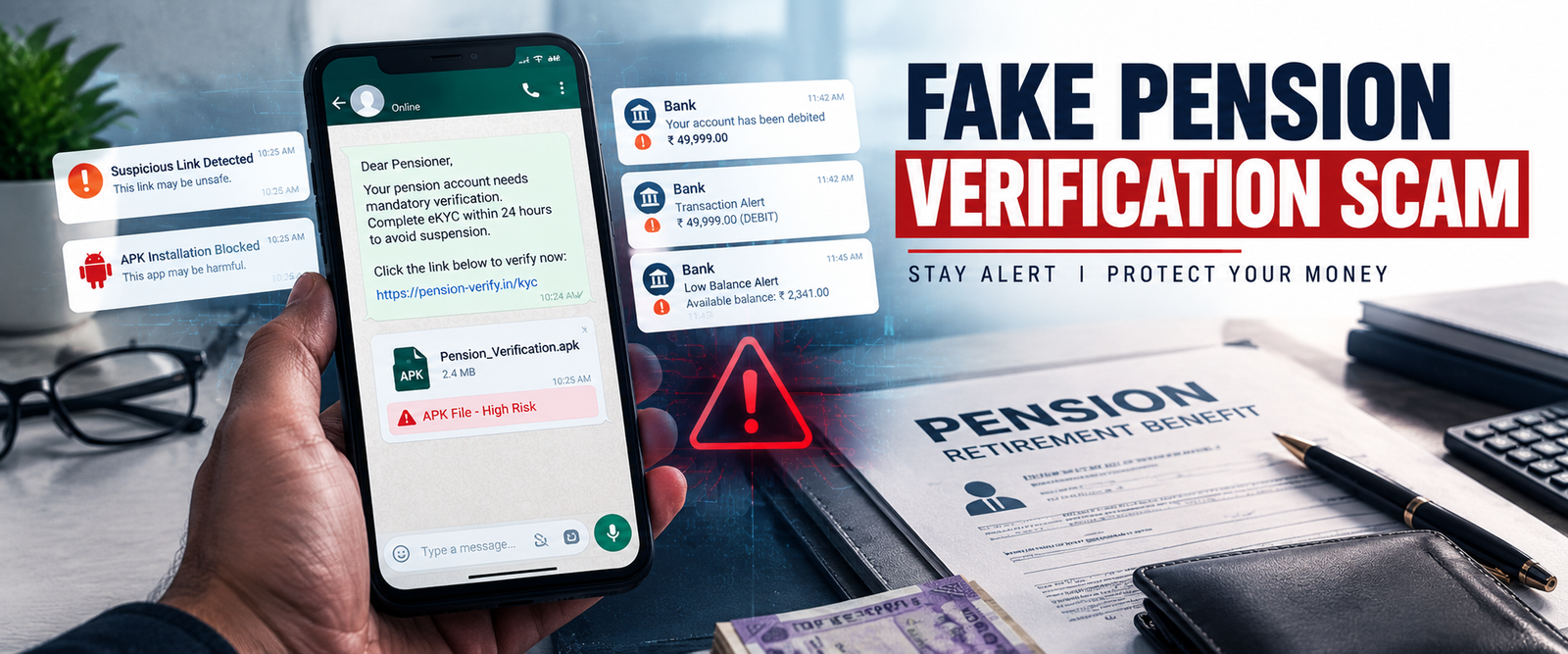
Fake Pension Verification Scam has become a serious warning for pensioners and their families after a 65-year-old retired Army personnel from Pune district, Maharashtra, allegedly lost ₹28.7 lakh following a suspicious pension-related message received on WhatsApp.
According to police, the incident began on September 11, 2026, when the retired Army man received a message from an unknown number. The message reportedly contained a link to an APK file presented as a pension verification application. Believing that it was connected with his pension, he allegedly downloaded and opened the file.
The incident highlights how cybercriminals can misuse familiar subjects such as pension verification, banking services and account-related procedures to make fraudulent communication appear genuine. Police have registered a case and the investigation is continuing.
How the Fake Pension Verification Scam Allegedly Started
The Fake Pension Verification Scam reportedly began with a WhatsApp message that appeared to be related to pension verification.
This type of communication can appear convincing because the subject is directly connected with the recipient’s financial affairs. A message mentioning pension verification, KYC, account updates or other familiar banking procedures may not immediately appear suspicious.
In the reported case, the message allegedly directed the victim toward an APK file with a pension-related name. After the application was opened, the situation reportedly progressed to a phone call and subsequent unauthorised financial transactions.
Why an Unknown APK File Can Be Dangerous
APK stands for Android Package Kit and is a file format used to install applications on Android devices.
The main concern arises when an unknown person sends an APK through WhatsApp or another messaging platform and asks the recipient to install it. An unfamiliar application may request access to sensitive information or device functions.
People should therefore be particularly cautious when an unexpected financial or pension-related message is combined with a request to download an application.
An APK file should not be considered trustworthy simply because its name contains words such as pension, verification, bank or government.
The Caller Allegedly Claimed to Be a Bank Employee
According to the reported details, the victim received another phone call after opening the APK file.
The caller allegedly introduced himself as a bank employee and spoke about assistance related to the pension account. The victim was reportedly asked to keep his mobile phone switched on.
Several OTP messages then appeared on the phone. The caller allegedly told the victim not to share the OTPs, while transaction alerts later indicated activity involving his accounts.
Police reportedly found that nine unauthorised transactions took place within approximately three hours, involving a total amount of ₹28.7 lakh.
The sequence shows why a caller’s claim of being a bank employee should never be accepted without independent verification.
Warning Signs of a Pension Cyber Fraud
There are several warning signs that pensioners and families should take seriously.
Unexpected WhatsApp Messages
An unsolicited message from an unknown number claiming to represent a bank, pension authority or other organisation should be verified independently.
Requests to Install an APK
An unexpected application file should be treated with caution, particularly when it comes from an unknown contact.
Urgent Verification Requests
Messages suggesting that pension payments, accounts or benefits could be affected unless immediate action is taken can be designed to create pressure.
Unverified Phone Calls
Someone claiming to be a bank employee or official may sound convincing, but the identity should be verified through an official channel obtained independently.
Unexpected OTPs
Receiving OTPs when no transaction has been initiated can be an important warning sign. It should not be ignored.
Unfamiliar Banking Transactions
Any transaction that the account holder does not recognise should be reported to the bank immediately through an official channel.
How Fraudsters Can Make a Message Look Genuine
Cyber fraud does not always begin with an obviously suspicious message.
Fraudsters may choose a subject that is already relevant to the target. Pensioners may receive pension-related messages, while other people may receive messages about KYC, insurance, electricity bills, courier deliveries or bank accounts.
The purpose is often to create familiarity before encouraging the recipient to click a link, install an application or follow instructions.
This is why checking the source of a digital message is important. Similar warning signs can also appear in email-based scams, including suspicious senders, unexpected links and urgent requests. Our guide on How to Identify a Fake Email explains these warning signs in greater detail.
Pensioners and Families Should Stay Alert
Older people can sometimes be targeted through communication that appears familiar or official.
Families can help elderly relatives by discussing common cyber-fraud warning signs and encouraging them to verify unusual messages before taking any action.
The goal is not to create fear around digital banking or messaging applications. Instead, people should develop the habit of checking unexpected requests before downloading software, opening suspicious links or following instructions from unknown callers.
What to Do If an Unauthorised Transaction Appears
If an unfamiliar transaction appears in a bank account, it is important to act quickly.
The concerned bank should be contacted immediately through its official communication channel. The incident should also be reported through the appropriate cybercrime reporting system.
In the reported Pune case, the incident was reported to the authorities after the suspicious transactions were noticed, and police subsequently registered an FIR.
People can also follow the latest developments and awareness reports through the Cyber Fraud News section to understand how different forms of online financial fraud are being reported.
Do Not Trust a Caller Simply Because They Know Your Details
A fraudster may already know a person’s name, bank name or other basic information. That does not prove that the caller is genuine.
People should avoid sharing passwords, PINs, OTPs, card details or banking credentials with unknown callers.
If someone claims to represent a bank or government organisation, it is safer to end the conversation and contact the organisation independently using an official website or verified contact number.
Financial Fraud Can Involve Multiple Forms of Deception
Financial fraud is not always limited to a single suspicious transaction.
A case may involve impersonation, misleading messages, social engineering, suspicious applications and unauthorised transfers. Understanding the broader nature of financial fraud can help people recognise that different warning signs may be connected.
For general information about financial fraud cases and investigation-related concerns, readers can also refer to Financial Fraud Investigation.
The circumstances of every case are different, and any allegation should be assessed according to the available evidence and findings of the relevant authorities.
Why Immediate Reporting Matters
Once unauthorised financial activity is discovered, the suspected fraudster should not be confronted or trusted to reverse the transaction.
The bank and appropriate authorities should be contacted as soon as possible.
Relevant information such as transaction alerts, phone numbers, messages and other available records may be useful when reporting the incident.
In the reported case, police said that ₹28.7 lakh was transferred through nine transactions over a short period. The speed of the transactions demonstrates why delaying a complaint can be risky.
A Wider Cybersecurity Lesson
The Fake Pension Verification Scam reported in Maharashtra is not only a warning about pension-related messages. It also demonstrates how different forms of deception can be combined during a cyber fraud.
A WhatsApp message may create the initial contact. An unfamiliar application may then become part of the next stage. A caller claiming to be a bank employee can add another layer of credibility before financial transactions take place.
Recognising these warning signs early can help people respond more carefully.
Final Thoughts
The reported ₹28.7 lakh loss involving a retired Army personnel in Pune is a reminder that pension-related digital communication should always be verified carefully.
The Fake Pension Verification Scam allegedly involved a WhatsApp message, an APK file, a caller claiming to be a bank employee and a series of unauthorised transactions. Police have registered a case and the investigation is continuing, so the reported allegations should not be treated as court-established facts.
For pensioners and their families, the practical lesson is simple: do not install an unfamiliar APK because of an unexpected message, do not rely on an unverified caller’s instructions, and report unfamiliar banking activity without unnecessary delay.
Careful verification before taking action can help reduce the risk of serious financial loss.

