

-
vigilantinvestigationagency@gmail.com
Send Email
-
Bharthal, Dwarka Sector 26, New Delhi – 110077, India
Visit Our Office
+91 62-995 5-3308
Confidentiality Guaranteed
+91 62-995 5-3308
Confidentiality Guaranteed
Blog Details
-
vigilant Investigation Agency. > Crime News > Legal and Safe Ways to Protect Yourself from Online Blackmail
16
Sep
Sep
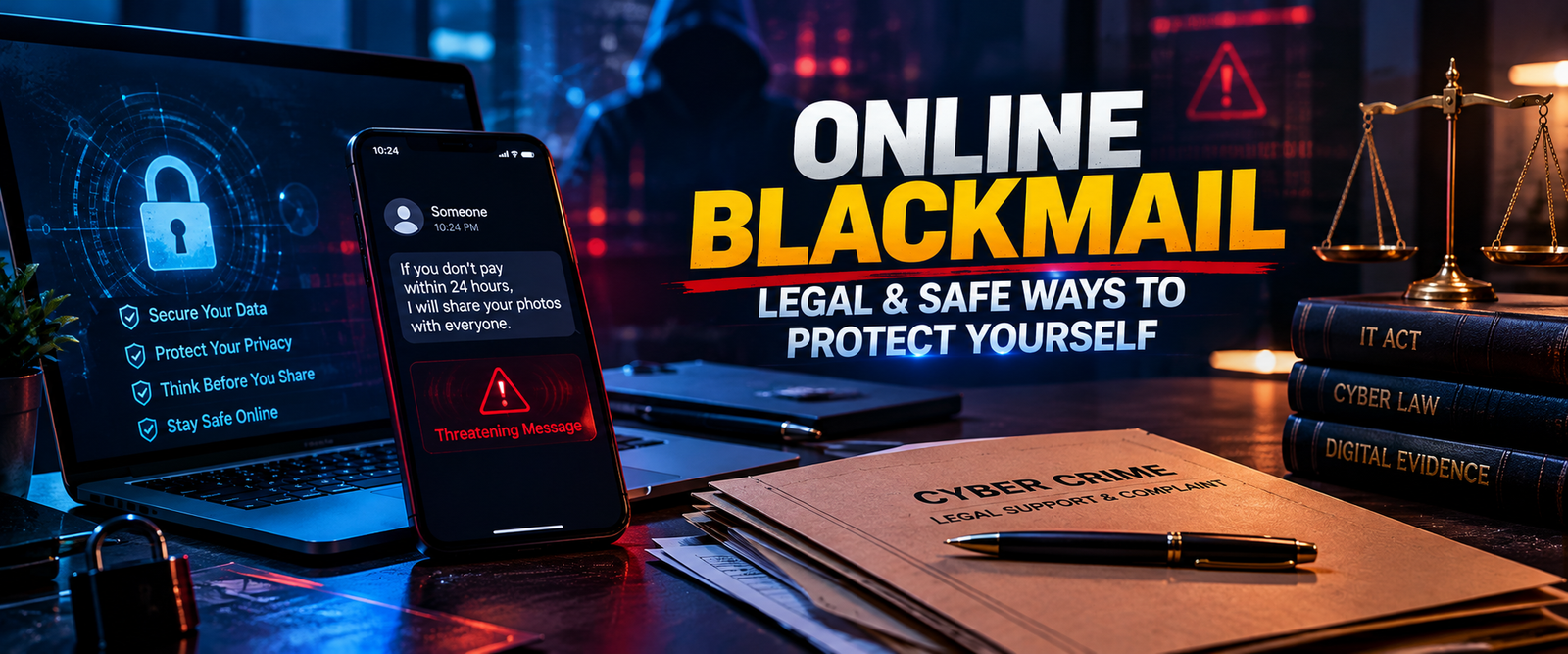
Legal and Safe Ways to Protect Yourself from Online Blackmail
In today’s digital age, the use of social media, WhatsApp, Instagram, Telegram, email and other online platforms has increased rapidly. Along with the growing use of digital platforms, cases involving online blackmail, cyber harassment and digital threats have also become a serious concern.
Online blackmail occurs when someone threatens to publish or misuse a person’s private photos, videos, chats, recordings or other personal information and demands money, personal information, meetings or some other benefit in return.
In such situations, staying calm and taking safe and lawful steps is extremely important.
What Is Online Blackmail?
Online blackmail generally refers to a situation where a person uses digital platforms or electronic communication to threaten someone with the publication, misuse or distribution of private information, photographs, videos, chats or other personal material.
The threat may be accompanied by a demand for money, personal information, continued communication or another form of benefit.
Online blackmail can occur through WhatsApp, Instagram, Facebook, Telegram, email, video calls, dating platforms and other digital services.
What Should You Do First If You Are Being Blackmailed Online?
1. Do Not Panic or Immediately Send Money
Blackmailers may create fear and pressure the victim into making an immediate payment.
However, paying money does not necessarily guarantee that the situation will end. In some cases, the person may continue making further demands.
Avoid making rushed financial decisions and consider seeking appropriate legal or law-enforcement assistance.
2. Preserve All Digital Evidence
Keep all relevant evidence safely preserved.
This may include:
Screenshots of threatening messages
Emails and email addresses
Social media usernames and profile links
Phone numbers
Chat conversations
Payment requests or transaction details
Website or content URLs
Relevant photographs or videos
Other information connected with the incident
The National Cyber Crime Reporting Portal provides information about supporting evidence such as emails, URLs, chat transcripts, screenshots, videos, images and other documents.
Do not unnecessarily edit or alter the original evidence. Keep copies in a secure location.
3. Do Not Threaten or Confront the Blackmailer
Avoid abusing, threatening or attempting to take revenge against the person involved.
Direct confrontation can sometimes make the situation more complicated.
Instead, remain calm, preserve the available evidence and consider reporting the matter through the appropriate authorities or platform.
4. Strengthen Your Account and Privacy Settings
Review the privacy and security settings of your social media and other online accounts.
Avoid sharing sensitive personal information, private photographs, location details or contact information with unknown people.
Where available, enable Two-Factor Authentication (2FA), use strong passwords and avoid using the same password across multiple accounts.
5. Report and Block Suspicious Accounts
After preserving relevant evidence, you can report the suspicious account, message or content through the respective social media or online platform.
The National Cyber Crime Reporting Portal also provides facilities for reporting certain suspicious identifiers, including phone numbers, WhatsApp or Telegram handles, email IDs, website URLs and social media URLs.
Where Can You Report Online Blackmail in India?
Cyber crime complaints in India can be submitted through the National Cyber Crime Reporting Portal.
The portal provides different reporting options for cyber crime complaints, including the “Other Cyber Crime” category.
National Cyber Crime Reporting Portal:
https://www.cybercrime.gov.in/
If money has already been lost through an online financial fraud, contacting the Cyber Crime Helpline 1930 as soon as possible is important.
For an immediate emergency requiring police assistance, the national emergency number 112 can be used.
Can Online Blackmail Become a Legal Case?
Yes. Depending on the facts and circumstances, online blackmail may involve different criminal offences.
The applicable legal provisions can depend on factors such as:
The nature of the threat
Financial demands
Extortion
Harassment
Misuse of private information
Distribution or threatened distribution of private content
Identity-related misuse
Other circumstances of the incident
India’s current criminal law framework includes the Bharatiya Nyaya Sanhita, 2023.
However, the exact legal provisions applicable to a particular case depend on the facts, available evidence and investigation. Police and competent legal authorities determine the applicable provisions based on the circumstances.
Therefore, people should avoid reaching a final legal conclusion about a specific case based only on general information available online. Professional legal advice may be appropriate where necessary.
What If Someone Threatens to Leak Private Photos or Videos?
If someone is threatening to publish or distribute private photographs or videos, do not allow fear to force you into immediately fulfilling every demand.
Consider taking the following steps:
Preserve screenshots of threatening messages
Record the username and profile URL
Preserve the relevant phone number
Keep the complete email and related information
Preserve payment requests or transaction details
Report the account or content to the relevant platform
Submit a complaint through the National Cyber Crime Reporting Portal
Contact local police when necessary
If the content has already been uploaded online, preserve the relevant URL and screenshots as evidence.
Avoid further distributing or forwarding private content unnecessarily.
Why Should You Tell Someone You Trust?
Blackmailers may try to convince victims that telling family members, friends or authorities will make the situation worse.
However, dealing with online blackmail alone can be difficult.
Speaking to a trusted family member, friend or another responsible person can provide emotional support and help you make safer decisions.
Most importantly, remember that being targeted by a cybercriminal is not something you should feel ashamed about.
Should You Feel Ashamed If You Become a Victim of Online Blackmail?
No.
Being a victim of cyber crime is not the victim’s fault.
Cybercriminals may use fear, embarrassment and social pressure to control their targets. The most important steps are to preserve evidence, remain calm and report the matter to the appropriate authority.
Special Precautions in Cases Involving Children or Women
If the matter involves a child or sexually explicit private content, do not forward, circulate or unnecessarily share the material with other people.
Such cases should be reported through the appropriate options available on the National Cyber Crime Reporting Portal or to the relevant law-enforcement authority.
When dealing with sensitive digital material, protecting the privacy of the victim is extremely important.
Important Safety Measures to Prevent Online Blackmail
You can reduce your exposure to online blackmail by following some basic digital safety practices:
Avoid sharing private content with unknown people.
Regularly review your social media privacy settings.
Use strong and unique passwords for different accounts.
Enable Two-Factor Authentication wherever available.
Avoid clicking suspicious links or downloading unknown files.
Be careful while sharing personal information during online conversations or video calls.
Avoid making excessive personal information publicly available on social media.
Report suspicious accounts, messages or content to the relevant platform.
Keep important digital accounts protected with updated security settings.
Be cautious when communicating with people whose identity you cannot independently verify.
What Should You Avoid Doing?
When facing online blackmail, avoid the following:
Do not panic.
Do not immediately send money simply because you are being threatened.
Do not delete important evidence.
Do not threaten the blackmailer.
Do not attempt revenge or illegal retaliation.
Do not unnecessarily forward private photographs or videos.
Do not share sensitive evidence publicly on social media.
Do not ignore serious threats when immediate safety may be involved.
Conclusion
Online blackmail can be a serious cyber crime situation, but remaining silent out of fear is not the solution.
If someone is threatening you using private photographs, videos, chats or personal information, remain calm, preserve the available evidence and avoid making rushed decisions.
You can report cyber crime through the National Cyber Crime Reporting Portal and, where applicable, contact the 1930 Cyber Crime Helpline for assistance with financial cyber fraud.
If the situation involves serious threats, continued harassment, misuse of personal information or an immediate safety concern, consider contacting the appropriate law-enforcement authority and seeking qualified legal assistance.
Vigilant Investigation Agency
Online fraud, cyber harassment, digital threats, background verification and other investigation-related concerns may require professional assistance.
Vigilant Investigation Agency (VIA) provides professional investigation-related services in Delhi and across India, with an emphasis on confidentiality, discretion and responsible handling of sensitive matters.
If you believe you are facing a serious online threat or require professional assistance regarding an investigation-related matter, you can contact Vigilant Investigation Agency for further information.

