

-
vigilantinvestigationagency@gmail.com
Send Email
-
Bharthal, Dwarka Sector 26, New Delhi – 110077, India
Visit Our Office
+91 62-995 5-3308
Confidentiality Guaranteed
+91 62-995 5-3308
Confidentiality Guaranteed
Blog Details
-
vigilant Investigation Agency. > News > Philippines-Routed WhatsApp Numbers and Cyber Fraud: How International Scam Networks Operate
12
Sep
Sep
Philippines-Routed WhatsApp Numbers and Cyber Fraud: How International Scam Networks Operate
An Odisha Cybercrime Case Raises Questions About Cross-Border Scam Networks
Cyber fraud is no longer limited by geographical boundaries.
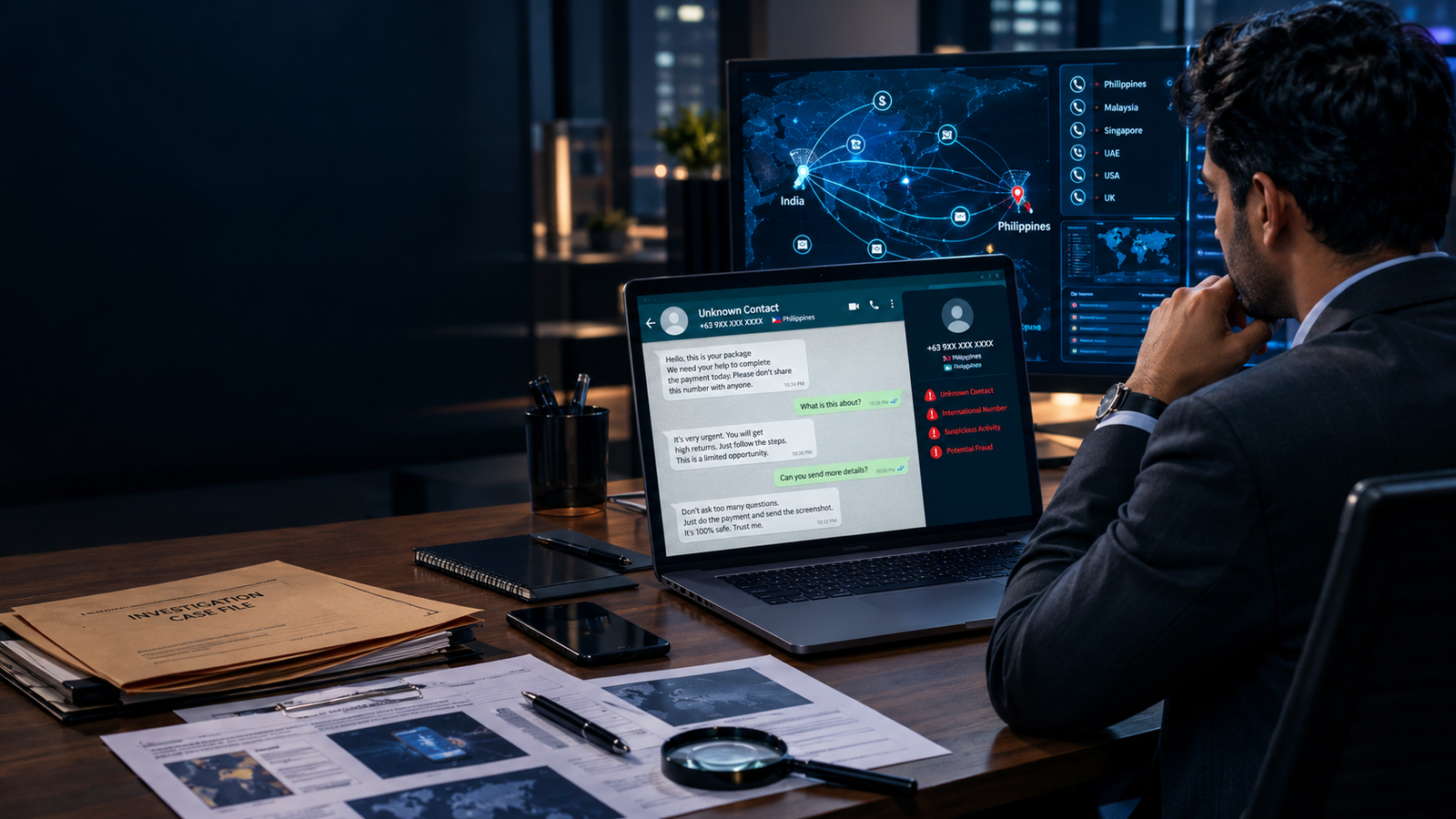
A recent case reported from Odisha has highlighted how organised cybercrime networks may use foreign-routed communication channels as part of fraudulent operations. According to a report published on September 11, 2026, Balangir Police arrested four people in connection with an alleged cybercrime network that reportedly used Philippines-routed WhatsApp numbers to coordinate cyber-fraud activities and make detection more difficult.
The case raises an important question:
When a fraudster contacts you through an international or foreign-routed number, what does it actually tell you about the person behind the account?
The answer is not always straightforward.
A foreign WhatsApp number does not automatically mean that the person contacting you is a criminal. People legitimately use international numbers for travel, business, work, family connections and other reasons.
However, when a foreign number appears together with suspicious behaviour, false identities, financial requests or other warning signs, it may deserve closer attention.
What Happened in the Odisha Cybercrime Case?
According to the reported case, Balangir district police uncovered an organised cybercrime network and arrested four alleged members.
Investigators reportedly found that Philippines-routed WhatsApp numbers were being used in connection with cyber-fraud operations. The reported use of foreign-routed communication channels allegedly helped the network coordinate activities and evade detection.
The investigation is reportedly examining the wider network and possible international connections.
This is important because modern cybercrime operations can involve multiple layers:
- A person operating from one location
- A phone number associated with another country
- Internet-based communication services
- Bank accounts or digital payment channels belonging to different individuals
- Multiple intermediaries
- Victims located in completely different regions
This makes cyber-fraud investigation considerably more complex than simply identifying the phone number displayed on a victim’s screen.
What Does “Philippines-Routed WhatsApp Number” Mean?
A WhatsApp number associated with another country does not necessarily reveal the physical location of the person using it.
Internet-based communication can involve different technical and service layers. A person may be physically located in one country while using a number associated with another country.
A phone number’s country code should not automatically be treated as proof of a person’s physical location.
This distinction is particularly important during cybercrime investigations.
For example, if a victim receives a WhatsApp message from a foreign number, it would be incorrect to immediately conclude that the sender is physically located in that country.
Investigators generally need to examine multiple pieces of evidence rather than relying on a single number.
Why Do Cybercriminals Use International Communication Channels?
Organised fraud networks may attempt to create distance between themselves and their victims.
Depending on the nature of the operation, criminals may use different communication accounts, internet services, intermediaries or identities to make attribution more difficult.
1. Creating an Appearance of Legitimacy
A foreign business or international contact may sometimes appear more credible to an unsuspecting victim.
Fraudsters can exploit this perception by presenting themselves as:
- Overseas business representatives
- Investment consultants
- Recruitment agents
- Online service providers
- Customer-support representatives
- International traders
- Relationship or matrimonial contacts
2. Making Identification More Difficult
When several communication channels and intermediaries are involved, identifying the actual person behind the fraud can become more complicated.
3. Coordinating Multiple Victims
Organised cybercrime groups may operate at scale rather than targeting only one victim.
Different people may perform different roles, such as contacting victims, maintaining communication, collecting information or handling financial transactions.
4. Creating Multiple Layers
A fraud operation may involve several digital and financial layers between the victim and the person ultimately controlling the operation.
This is one reason why cybercrime investigations often require analysis of multiple types of evidence.
How Can an International Scam Network Operate?
Every case is different, but organised cyber fraud can follow a structure involving several stages.
Stage 1: Finding Potential Victims
Fraudsters may identify victims through social media, messaging platforms, online advertisements, job portals, investment groups or other digital platforms.
Stage 2: Establishing Contact
The victim may then receive a WhatsApp message, phone call, email or social-media communication.
The initial conversation may appear completely normal.
Stage 3: Building Trust
The fraudster may spend time creating credibility before making a financial request.
This is often one of the most dangerous stages because victims may not initially recognise the interaction as fraudulent.
Stage 4: Creating Urgency
Once trust has been established, the victim may be told that immediate action is required.
Examples can include:
- Limited investment opportunities
- Urgent payment requirements
- Account verification
- Customs or clearance charges
- Job registration fees
- Loan processing charges
- Emergency situations
- Refund or recovery fees
Stage 5: Moving Money
The victim may eventually be instructed to transfer money through a bank account, wallet, payment application or other financial channel.
Stage 6: Disappearing or Continuing the Fraud
After receiving money, the fraudster may stop responding or introduce another excuse requiring additional payment.
Why WhatsApp Alone Cannot Tell You Who Is Behind a Fraud
One common mistake is assuming that the WhatsApp profile itself proves the identity of the person.
A profile photograph, name, business description or phone number can be misleading.
A fraudster may use:
- A false name
- Someone else’s photograph
- A fake business identity
- A copied company logo
- A foreign number
- Multiple accounts
- Temporary or disposable communication channels
Therefore, investigators should avoid treating a WhatsApp profile as conclusive proof of identity.
Digital identity and real-world identity are not always the same thing.
What Are the Warning Signs of an International Cyber Scam?
A foreign number by itself is not enough to establish fraud.
However, several warning signs appearing together should increase caution.
Watch for:
- Unexpected contact from an unknown international number
- Pressure to act quickly
- Requests for money
- Requests for cryptocurrency or unusual payment methods
- Investment promises involving guaranteed returns
- Fake employment opportunities
- Requests to install unknown applications
- Requests for OTPs, passwords or sensitive information
- Inconsistent identity or employment details
- Refusal to provide verifiable information
- Multiple excuses for requesting additional payments
- Fake websites or documents
- Attempts to move the conversation across multiple platforms
The more warning signs appear together, the more important independent verification becomes.
What Information Should a Victim Preserve?
If you suspect that you are dealing with an online scam, do not immediately delete the conversation.
Communication Evidence
- WhatsApp messages
- Emails
- Phone numbers
- Usernames
- Profile photographs
- Relevant voice messages
- Screenshots
- Dates and times of communication
Financial Evidence
- Bank transaction records
- UPI transaction details
- Payment receipts
- Account numbers provided by the suspect
- Transaction IDs
- Wallet information, where applicable
Digital Evidence
- Suspicious website addresses
- Emails and their headers where available
- Files or documents sent by the suspect
- Screenshots of advertisements
- Relevant social-media profiles
Preserving original information can be important because evidence may later become unavailable.
What Should You NOT Do?
If you suspect cyber fraud, do not attempt to investigate by hacking into another person’s account or device.
Do not:
- Guess or steal passwords
- Install spyware
- Attempt unauthorised account access
- Track someone’s private device without lawful authority
- Threaten the suspected person
- Publish unverified accusations online
- Send additional money simply because the suspect promises recovery
Such actions can create additional legal and security risks.
How Can Cybercrime Investigations Trace a Fraud Network?
A cybercrime investigation is usually much broader than checking one phone number.
Depending on the case and legal authority involved, investigators may examine multiple categories of information.
Communication Analysis
Relevant phone numbers, communication patterns and account information may help establish connections between individuals or entities.
Financial Analysis
Money movement can sometimes reveal relationships between different accounts and intermediaries.
Digital Evidence
Devices, documents, emails, websites and other digital records may provide additional evidence.
Identity Verification
Investigators may compare the identity claimed by an individual with independently available information.
Timeline Reconstruction
Creating a chronological timeline of communications, transactions and events can help investigators understand how the alleged fraud occurred.
Network Mapping
In larger cases, investigators may attempt to identify relationships between different individuals, accounts, phone numbers and financial channels.
This is why a professional investigation should focus on connecting evidence, rather than relying on a single clue.
Why Cross-Border Cybercrime Is Difficult to Investigate
International cybercrime can involve several jurisdictions.
A victim may be located in India, the suspect may use a foreign-associated number, the communication platform may operate internationally, and the money may move through multiple financial channels.
This creates challenges involving:
- Jurisdiction
- Digital evidence
- Data preservation
- Cross-border cooperation
- Identity attribution
- Financial tracing
- Multiple intermediaries
Law-enforcement agencies may therefore need cooperation from relevant authorities, service providers and financial institutions depending on the circumstances of the case.
What Can a Private Investigation Agency Do?
A private investigation agency should not be confused with law-enforcement authorities.
Private investigators do not have unrestricted access to telecom records, private accounts, platform databases or confidential government information.
However, within the lawful scope of an assignment, professional investigators may assist clients with areas such as:
- Background verification
- Identity verification
- Business verification
- Open-source research
- Digital information review
- Timeline preparation
- Evidence organisation
- Field verification
- Documentation of relevant findings
The exact scope depends on the case, available information and applicable legal requirements.
Where a matter involves an alleged cybercrime, financial fraud or unauthorised access, the appropriate law-enforcement or cybercrime authorities should also be considered.
Why Evidence Matters More Than Assumptions
Cybercrime investigations can quickly become complicated when victims rely on assumptions.
For example:
“The number is from another country, so the person must be sitting in that country.”
That conclusion may not be accurate.
Similarly:
“The WhatsApp profile has a real photograph, so the person must be genuine.”
That also cannot be assumed.
A stronger investigation approach is to ask:
- What information can be independently verified?
- What evidence connects the different accounts?
- Are the identity claims consistent?
- Where did the money go?
- What communications occurred before the transaction?
- Are there contradictions in the information provided?
This approach shifts the investigation from assumption to evidence.
How Can You Protect Yourself From International Cyber Fraud?
A few simple precautions can reduce risk:
Verify Before You Trust
Do not rely solely on a WhatsApp profile, phone number or photograph.
Never Share Sensitive Credentials
Never share OTPs, passwords, PINs or other authentication information with an unknown person.
Be Careful With Investment Offers
Guaranteed or unusually high returns should be treated with caution.
Do Not Rush
Fraudsters often use urgency to prevent victims from thinking carefully.
Verify Businesses Independently
If someone claims to represent a company, verify the organisation through independently obtained official information.
Preserve Evidence
If something appears suspicious, preserve relevant messages, payment records and digital information.
Report Suspected Cybercrime
If you believe you have been defrauded, report the matter through the appropriate official cybercrime and law-enforcement channels.
The Bigger Lesson From the Odisha Case
The reported Odisha case is a reminder that cyber fraud is becoming increasingly organised and can involve international digital infrastructure.
The use of a foreign-routed communication number does not, by itself, prove criminal activity.
But the case demonstrates why investigators and victims should look beyond the visible phone number.
The real questions are:
Who is behind the identity?
What connections exist between the different digital accounts?
Where did the money move?
What evidence connects the individuals involved?
These questions are much more important than simply asking which country appears on a phone number.
Final Takeaway
International cyber fraud is not always a simple case of one person contacting another person.
Modern scams can involve multiple identities, communication channels, financial accounts and intermediaries.
The recent Odisha case involving alleged use of Philippines-routed WhatsApp numbers shows why cyber-fraud investigations can require a broader evidence-based approach.
For individuals and businesses, the most important lesson is simple:
Do not trust a digital identity merely because it looks convincing. Verify important information before sending money, sharing sensitive information or entering into a significant financial or professional relationship.
And if fraud is suspected, preserve the evidence, avoid unauthorised investigation methods and approach the appropriate authorities.
Vigilant Investigation Agency
Private Investigation | Cyber Investigation | Background Verification | Matrimonial Verification | Corporate Investigation
Confidentiality • Professional Approach • Clear & Detailed Investigation Reports
Disclaimer:
This article is published for general awareness and informational purposes. The Odisha incident referenced above is based on media reporting and allegations reported by authorities; the use of a foreign or international phone number alone does not establish that a person is involved in cybercrime. Any investigation should be conducted lawfully and in accordance with applicable legal and privacy requirements.
This article is published for general awareness and informational purposes. The Odisha incident referenced above is based on media reporting and allegations reported by authorities; the use of a foreign or international phone number alone does not establish that a person is involved in cybercrime. Any investigation should be conducted lawfully and in accordance with applicable legal and privacy requirements.

